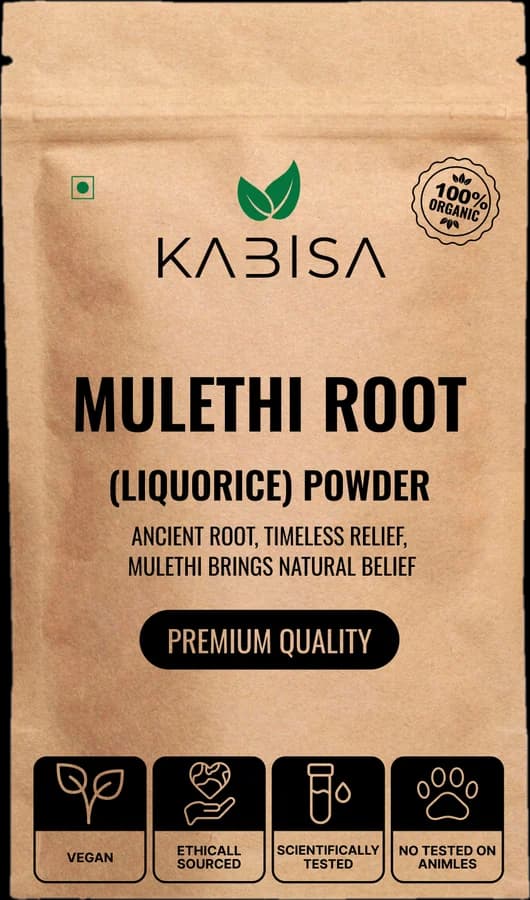
Mulethi Powder (Licorice Root)
Licorice root (mulethi, yashtimadhu) ground into a naturally sweet, woody powder. A winter favourite in kadha and herbal tea.
- 100% licorice (mulethi) root
- Naturally sweet, woody taste
- For kadha, herbal tea and chai
- A pinch is enough
- 100 g, 200 g and 400 g packs
Incl. of all taxes · 100 g
- Ships across India
- UPI and cards
- FSSAI licensed
About Mulethi Powder.
Mulethi is licorice root (*Glycyrrhiza glabra*), known in Sanskrit as yashtimadhu, "the sweet stick". In many Indian homes a small piece of mulethi is chewed, or the powder is added to kadha, especially in winter.
Our mulethi powder is 100% licorice root, dried and ground. Nothing is added.
What does mulethi taste like?
Naturally sweet, woody and slightly anise-like, the flavour behind licorice sweets. Mulethi is much sweeter than it looks, so a little goes a long way.
How mulethi powder is used
- Kadha: add a pinch to your kadha with tulsi, ginger, black pepper and cinnamon while it simmers.
- Herbal tea: a pinch in hot water with ginger and honey.
- Warm water: a quarter teaspoon with honey.
- Chai: a pinch in masala chai adds a gentle sweetness.
How much to use
A pinch to a quarter teaspoon at a time is the usual amount. Licorice is strong, and it isn't meant for large amounts or long daily use.
A word of care
Licorice isn't suitable for everyone. If you have high blood pressure, heart or kidney problems, low potassium, are pregnant or breastfeeding, or take medicines (including blood pressure tablets or steroids), please ask your doctor before using mulethi. Keep servings small.
Best before: 12 months from the date of packing.
How to use it
Add a pinch to tea or warm water with honey.
Product details
- Ingredients
- 100% mulethi (licorice) root
- Net quantity
- 100 g · 200 g · 400 g
- Best before
- 12 months from the date of packing
- Storage
- Cool, dry place, away from sunlight.
- Packed by
- Kabisa Organics, 230 Avadh Viceroy, Sarthana Jakatnaka, Surat 395006
- Country of origin
- India
- FSSAI Lic. No.
- 20725031004161
- Customer care
- help@kabisa.in · +91 90990 00489
Questions
What is mulethi called in English?
Licorice (or liquorice) root. In Sanskrit it is called yashtimadhu.
How do I use mulethi powder?
Add a pinch to kadha, herbal tea or masala chai while it simmers, or stir a quarter teaspoon into warm water with honey.
How much mulethi powder can I take in a day?
Keep it to a pinch or up to a quarter teaspoon, and not for long periods every day. Ask your doctor if you want to use it regularly.
Who should avoid mulethi?
People with high blood pressure, heart or kidney problems, or low potassium, pregnant or breastfeeding women, and anyone on blood pressure medicines or steroids should ask their doctor first.
Why is mulethi sweet?
Licorice root naturally contains glycyrrhizin, which tastes many times sweeter than sugar.
Can I add it to masala chai?
Yes. A pinch while the chai simmers adds a gentle, woody sweetness.
How should I store it?
Keep the pack sealed in a cool, dry place away from sunlight, and always use a dry spoon.
Who packs it?
Kabisa Organics in Surat, Gujarat. FSSAI Lic. No. 20725031004161.
Known across India as.
Mulethi Powder (Licorice Root) has a name in almost every Indian language. Here is what people call it.
- English
- Licorice root, Liquorice root
- Hindi
- मुलेठी (mulethi), मुलहठी (mulhathi)
- Sanskrit
- यष्टिमधु (yashtimadhu)
- Gujarati
- જેઠીમધ (jethimadh)
- Marathi
- ज्येष्ठमध (jeshthamadh)
- Tamil
- அதிமதுரம் (athimathuram)
- Telugu
- అతిమధురం (atimadhuram)
- Kannada
- ಜೇಷ್ಠಮಧು (jeshtamadhu)
- Malayalam
- ഇരട്ടിമധുരം (irattimadhuram)
- Bengali
- যষ্টিমধু (jashtimadhu)
- Botanical
- Glycyrrhiza glabra
Reviews
No reviews yet. Bought Mulethi Powder (Licorice Root)? Tell others how you use it.